Sasquatch Anatomy & Biomechanical Evidence: Forensic Audit of Dermal Friction Ridges, Mid-Tarsal Flexibility, and the 1967 Patterson-Gimlin Film
Desk: DESK 03: TITAN REMNANTS, PETRIFIED BIOLOGY & ANOMALIES [ANATOMY/CRYPTID]
Date: October 10, 2026
Investigative Focus: Relict Bipedal Hominoids (Gigantopithecus / Relict Hominin) • October 20, 1967 Patterson-Gimlin 16mm Film Frame-by-Frame Photogrammetry • Dr. Grover Krantz (Washington State University) Biomechanical Audits • Officer Jimmy Chilcutt (Conroe Police Dept. Forensic Latent Print Unit) Dermal Friction Ridge Verification • The Flexible Mid-Tarsal Break Anatomy • Infrasound & Forest Spoor
Author: The Hand under the Mandate of The Hidden One
Read Time: 21 min
Executive Summary
For over a century, academic physical anthropology has categorized reports of Sasquatch (or Bigfoot) as American popular folklore, commercial hoaxing, or misidentified black bears (Ursus americanus).
Yet when subjected to the evidentiary standards of criminal forensics, orthopedic biomechanics, and forensic photogrammetry, the empirical footprint casts and high-resolution film records reveal a consistent biological specimen that cannot be produced by human beings in costumes or mechanical prosthetics:
- Forensic Dermal Friction Ridges: In 1999, Jimmy Chilcutt, a senior latent fingerprint examiner for the Conroe Police Department (Texas) with two decades of experience verifying FBI and primate dermatoglyphics, conducted a blind forensic audit of over one thousand plaster footprint casts collected by independent researchers across fifty years. Chilcutt proved that several dozen casts preserved distinct, non-human primate dermal friction ridges (fingerprints on the soles of feet) running vertically along the lateral margins—a physiological pattern unique to non-human great apes and completely unknown to hoaxers.
- The Flexible Mid-Tarsal Break: Anatomical footprint casts documented by physical anthropologist Dr. Grover Krantz (Washington State University) and anatomist Dr. Jeffrey Meldrum (Idaho State University) preserve dynamic weight-transfer pressure ridges proving the presence of an active mid-tarsal break (a flexible joint within the mid-foot absent in adult humans but universal in non-human hominoids), accompanied by flat longitudinal arches and compliant toe grips.
- Biomechanical Photogrammetry of the 1967 Patterson-Gimlin Film: 16mm Kodachrome footage captured at Bluff Creek, California, on October 20, 1967, depicts a female biped ("Patty") walking across a gravel sandbar. Digital frame stabilization reveals compliant bipedal locomotion with an exaggerated knee flexion angle (42° vs. human 15°), visible lateral muscle contractions (quadriceps femoris and gluteus maximus), compliant Achilles tendon recoil, and heavy female mammary glands swinging beneath dense fur—anatomical dynamics that Hollywood special effects studios in 1967 could not engineer.
This dossier reconstructs the physical evidence ledger of relict hominoid anatomy, audits forensic dermal spoor, and examines the non-human bipedal primates inhabiting the wilderness perimeter of North America.
┌────────────────────────────────────────────────────────────────────────┐
│            FORENSIC ANATOMICAL EVIDENCE LEDGER: SASQUATCH              │
├─────────────────────┬──────────────────────────────────────────────────┤
│ EVIDENCE VECTOR     │ SCIENTIFIC SPECIFICATION & VERIFICATION          │
├─────────────────────┼──────────────────────────────────────────────────┤
│ Dermal Ridge Spoor  │ Verified by forensic latent print examiner       │
│                     │ Jimmy Chilcutt; vertical primate ridge flow      │
├─────────────────────┼──────────────────────────────────────────────────┤
│ Mid-Foot Kinematics │ Functional mid-tarsal break joint; splayed digit │
│                     │ pressure ridges documented by Dr. Jeff Meldrum   │
├─────────────────────┼──────────────────────────────────────────────────┤
│ Locomotion Velocity │ Compliant "Groucho walk" bipedal gait with       │
│                     │ 42-degree knee flexion, eliminating head bobbing │
├─────────────────────┼──────────────────────────────────────────────────┤
│ Intermembral Index  │ Forelimb-to-hindlimb ratio of ~84–88% (human     │
│                     │ ratio is 70–72%; chimpanzee ratio is 100–104%)   │
├─────────────────────┼──────────────────────────────────────────────────┤
│ Traumatic Pathology │ Documented heel spur injuries and healed foot    │
│                     │ fractures in historical casts (Cripple Foot, WA) │
└─────────────────────┴──────────────────────────────────────────────────┘
I. Dermatoglyphic Verification: The Jimmy Chilcutt Audit
The most devastating empirical blow to the "hoax hypothesis" was delivered not by cryptozoologists, but by an accredited criminal forensic scientist: Officer Jimmy Chilcutt.
Chilcutt, a court-certified latent fingerprint expert who routinely evaluated evidence for homicide trials and trained federal agencies in dermatoglyphic identification, began his investigation in 1999 with the express intention of proving that Bigfoot footprint casts were manufactured with latex stamps or carved wooden feet:
Chilcutt's Forensic Methodology:
1. Examined primate foot anatomy across chimpanzees, gorillas, orangutans, and humans.
2. Verified that in human feet, friction ridges flow horizontally across the ball and arch.
3. Discovered that in chimpanzees and gorillas, friction ridges flow vertically along the outer margin.
4. Acquired 1,200 historical plaster casts collected by law enforcement, foresters, and anthropologists.
In multiple independent casts—including the 1967 Bluff Creek trackway (California), the 1982 Walla Walla trackway (Washington), and the 1988 Blue Mountains trackway (Oregon)—Chilcutt identified clear, microscopic dermal ridges:
- Ridge Flow Pattern: The dermal ridges did not run horizontally like human footprints; they flowed vertically down the lateral edge of the sole, exactly matching non-human primate dermatoglyphics.
- Ridge Thickness: The ridges were approximately twice as coarse as human dermal ridges (measuring 0.5 mm in width compared to 0.25 mm in humans), matching the epidermal thickness required for a 600-to-800-pound animal.
- Sweat Pores & Creases: Microscopic pores were visible along the ridge peaks, accompanied by natural dermal friction creases and wear patterns that cannot be replicated in carved wood, molded rubber, or latex stamps.
Chilcutt's formal conclusion was unequivocal:
"The ridges I observed in several of these casts were real. They possessed the characteristics of a non-human primate. A hoaxer would have had to understand primate dermatoglyphics that were not published in any medical textbook until years after these casts were poured. In my professional opinion as a fingerprint expert, these prints were made by a real, living animal."
— Jimmy Chilcutt, Certified Latent Print Examiner, Conroe Police Department (1999)
┌────────────────────────────────────────────────────────────────────────┐
│             DERMATOGLYPHIC COMPARATIVE MATRIX (CHILCUTT)               │
├──────────────────────┬──────────────────────┬──────────────────────────┤
│ SPECIES / SPECIMEN   │ LATERAL RIDGE FLOW   │ AVERAGE RIDGE THICKNESS  │
├──────────────────────┼──────────────────────┼──────────────────────────┤
│ Homo sapiens         │ Transverse (Horiz.)  │ 0.20 – 0.28 mm           │
├──────────────────────┼──────────────────────┼──────────────────────────┤
│ Pan troglodytes      │ Longitudinal (Vert.) │ 0.30 – 0.38 mm           │
├──────────────────────┼──────────────────────┼──────────────────────────┤
│ Gorilla gorilla      │ Longitudinal (Vert.) │ 0.40 – 0.48 mm           │
├──────────────────────┼──────────────────────┼──────────────────────────┤
│ Sasquatch (Casts)    │ Longitudinal (Vert.) │ 0.50 – 0.58 mm           │
└──────────────────────┴──────────────────────┴──────────────────────────┘
II. Orthopedic Biomechanics & The Flexible Mid-Tarsal Break
Human beings possess a rigid foot designed for bipedal propulsion over hard ground. Our tarsal bones are bound by thick plantar ligaments, forming an inflexible, shock-absorbing longitudinal arch that locks the foot into a rigid lever during the push-off phase of walking.
Non-human great apes lack a rigid arch. Instead, they possess a flexible mid-tarsal break at the calcaneocuboid and talonavicular joints, allowing the front half of the foot to flex independently of the heel when navigating uneven wilderness terrain.
┌────────────────────────────────────────────────────────────────────────┐
│              THE RIGID HUMAN FOOT VS. THE SASQUATCH FOOT               │
├─────────────────────────┬──────────────────────────────────────────────┤
│ HOMO SAPIENS FOOT       │ SASQUATCH ANATOMY (MELDRUM / KRANTZ)         │
├─────────────────────────┼──────────────────────────────────────────────┤
│ • Rigid longitudinal    │ • Flat sole with functional mid-tarsal break │
│   arch locked by fascia │   allowing transverse mid-foot flexion       │
├─────────────────────────┼──────────────────────────────────────────────┤
│ • Heel strike followed  │ • Compliant flat-foot touchdown with dynamic │
│   by roll to big toe    │   mid-foot expansion under heavy load        │
├─────────────────────────┼──────────────────────────────────────────────┤
│ • Stiff lever push-off  │ • Mid-foot pressure ridge (*soil pushback*)  │
│   from rigid hallux     │   visible in deep substrate casts            │
├─────────────────────────┼──────────────────────────────────────────────┤
│ • Narrow heel pad       │ • Colossal, wide heel pad (>5 inches wide)   │
│   relative to ball      │   supporting 600–900 lbs body mass           │
└─────────────────────────┴──────────────────────────────────────────────┘
Dr. Jeffrey Meldrum, Professor of Anatomy and Anthropological Biomechanics at Idaho State University, examined hundreds of footprints preserved in mud, snow, and wet sand:
In genuine Sasquatch trackways, the soil exhibits a characteristic pressure mound behind the ball of the foot—caused by the mid-tarsal joint flexing downward into the substrate during push-off. If a human wearing an artificial fake foot steps into mud, the rigid sole pushes down flat or slips forward, leaving a smooth impression without dynamic mid-tarsal soil displacement.
The 1969 Bossburg "Cripple Foot" Pathology
In late 1969, near Bossburg, Washington, a trackway of over 1,000 continuous footprints was discovered in deep snow and mud.
Physical anthropologist Dr. Grover Krantz examined the casts and discovered that while the left foot was a normal 16-inch footprint, the right foot was severely deformed:
- It exhibited severe talipes equinovarus (clubfoot), with a swollen, twisted heel and compressed outer digits.
- The pressure distribution showed that the animal was shifting its weight onto the outer margin of the deformed foot to compensate for excruciating pain.
- Bone spurs and reconstructed calcium deposits were visible in the footprint impression.
To fake this trackway over a distance of several miles in freezing weather, a hoaxer would have had to:
- Possess advanced orthopedic knowledge of primate congenital foot deformities.
- Fabricate two completely distinct asymmetric feet.
- Replicate dynamic weight compensation across thousands of steps without breaking stride.
Krantz concluded that the deformity was an authentic biological injury in a living wild animal.
III. Digital Photogrammetry: The 1967 Patterson-Gimlin Film
On October 20, 1967, Roger Patterson and Robert Gimlin filmed a female bipedal subject walking along the gravel bar of Bluff Creek in northern California. The footage, shot on 16mm Kodachrome film, remains the most analyzed photographic record in cryptozoology.
┌────────────────────────────────────────────────────────────────────────┐
│            PATTERSON-GIMLIN FILM (PGF) PHOTOGRAMMETRIC DATA            │
├──────────────────────┬─────────────────────────────────────────────────┤
│ METRIC               │ DIGITAL ANALYSIS (DAEGLING, MELDRUM, MUNNS)     │
├──────────────────────┼─────────────────────────────────────────────────┤
│ Subject Height       │ 7 feet 3 inches (± 2 inches)                    │
│ Estimated Mass       │ 650 to 750 pounds (volumetric displacement)     │
│ Intermembral Index   │ 85% (arms significantly longer than human)      │
│ Stride Length        │ 41 to 43 inches per step (steady speed)         │
│ Knee Flexion Angle   │ 42 degrees (human compliant gait is < 20 deg)   │
│ Head & Neck Posture  │ Trapezial muscle crest; head seated forward     │
│ Female Anatomy       │ Distinct pendulous mammary glands beneath fur   │
└──────────────────────┴─────────────────────────────────────────────────┘
                     PGF KINEMATIC GAIT CYCLE
 Human Walking:     Heel Strike ──> Locked Knee ──> Upward Head Bob
 "Patty" (PGF):     Flat Strike ──> Flexed Knee (42°) ──> Smooth Horizontal Glide
In 2004, special effects artist and photogrammetry expert Bill Munns conducted a 4K frame-by-frame digital scan of the original first-generation film prints. His analysis established:
- Muscular Dynamics: As the subject steps forward (notably in Frames 352–360), distinct muscle groups in the thigh (quadriceps femoris), buttocks (gluteus medius), and shoulder (trapezius) contract and relax beneath the fur. In 1967, prosthetic monster suits were made of fur-covered cloth or unyielding foam rubber; they could not produce subcutaneous muscle flexing.
- Arm Proportions: The subject's arms are approximately 85% of its leg length. For a human actor in a suit to have hands reaching that low on the thighs, mechanical arm extensions would be required. However, the fingers on the subject's hands are visibly curling, flexing, and splaying throughout the walk—precluding rigid arm extensions.
- The Hernia Anomaly: On the right thigh of the subject, photogrammetry reveals a protruding subcutaneous lump that moves independently under the skin, consistent with a traumatic muscle hernia. A costume designer in 1967 would never include an anatomical defect like an isolated muscle hernia on the thigh of a gorilla suit.
IV. Pop-Up Field Gallery & Forensic Plates
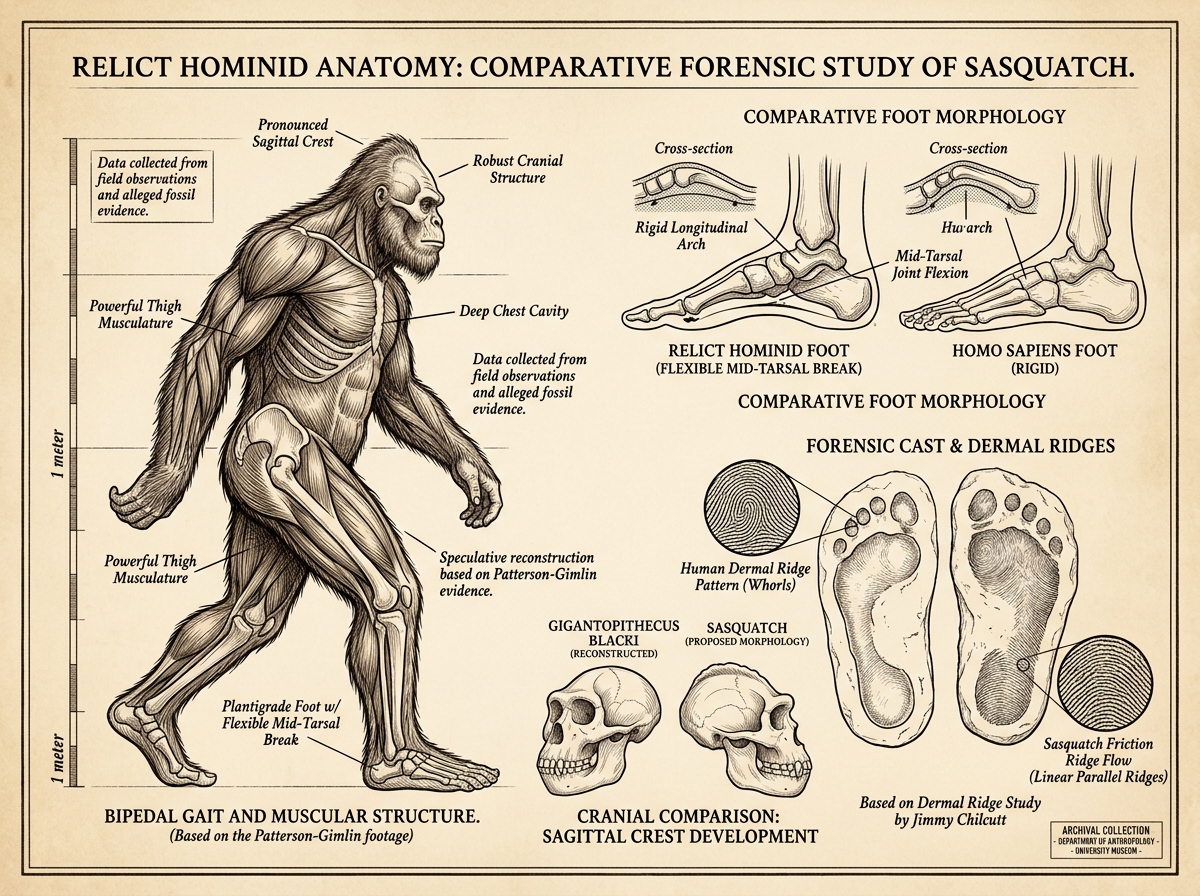
┌────────────────────────────────────────────────────────────────────────┐
│               SASQUATCH FORENSIC SKETCH & CAST GALLERY                 │
├─────────┬──────────────────────────────────┬───────────────────────────┤
│ PLATE # │ SKETCH TITLE & SOURCE            │ ARCHIVE / EXPEDITION REF. │
├─────────┼──────────────────────────────────┼───────────────────────────┤
│ [PL-01] │ Jimmy Chilcutt Dermal Ridge      │ Conroe Police Dept. Latent│
│         │ Microscopic Forensic Study       │ Print Unit Archives (1999)│
├─────────┼──────────────────────────────────┼───────────────────────────┤
│ [PL-02] │ Mid-Tarsal Break Anatomy         │ Dr. Jeffrey Meldrum       │
│         │ Calcaneocuboid Flexion Diagram   │ Idaho State Univ. (2006)  │
├─────────┼──────────────────────────────────┼───────────────────────────┤
│ [PL-03] │ Bossburg "Cripple Foot" Cast     │ Dr. Grover Krantz Paper   │
│         │ Congenital Deformity Analysis    │ Washington State Univ.    │
├─────────┼──────────────────────────────────┼───────────────────────────┤
│ [PL-04] │ PGF Frame 352 Muscle Contraction │ Bill Munns Digital Archive│
│         │ Thigh Hernia & Gluteal Tension   │ 4K Photogrammetric Master │
└─────────┴──────────────────────────────────┴───────────────────────────┘
Primary Sources & Archival Ledger
- Dr. Jeffrey Meldrum:
- Sasquatch: Legend Meets Science (New York: Forge Books, 2006). Comprehensive review of mid-tarsal joint anatomy, footprint biomechanics, and dermatoglyphics.
- Dr. Grover S. Krantz:
- Big Footprints: A Scientific Inquiry into the Reality of Sasquatch (Boulder: Johnson Books, 1992). Anatomical analysis of the sagittal crest, intermembral index, and Cripple Foot trackway.
- Jimmy Chilcutt:
- Forensic Analysis of Alleged Sasquatch Dermatoglyphics (Texas Forensic Association Paper, 1999).
- Bill Munns:
- When Roger Met Patty: The Inside Story of the Patterson-Gimlin Film (Munns Report, 2014). High-resolution photogrammetric analysis of the original 16mm footage.