Mokele-mbembe: Forensic Survey of the Likouala Peat Swamps and the Relict Sauropoda of the Congo Basin
Desk: DESK 03: TITAN REMNANTS, PETRIFIED BIOLOGY & ANOMALIES [ANATOMY/CRYPTID]
Date: October 10, 2026
Investigative Focus: Mokele-mbembe ("One Who Stops the Flow of Rivers") • Likouala Peat Swamps (55,000 sq mi) • Lake Tele & Likouala-aux-Herbes Basin • 1776 Abbé Bonaventure Proyart French Mission Chronicle • 1913 Captain Freiherr von Stein zu Lausnitz German Imperial Survey • 1980–1981 Dr. Roy P. Mackal (University of Chicago) Expeditions • 1983 Marcellin Agnagna (Brazzaville Zoo Directorate) Direct Lake Tele Observation • Forensic Sauropod Anatomical Morphology
Author: The Hand under the Mandate of The Hidden One
Read Time: 21 min
Executive Summary
Deep within the equatorial interior of the Republic of the Congo lies the Likouala Swamps—a nearly impenetrable 55,000-square-mile freshwater wetland basin composed of permanently flooded peat bogs, dense riparian canopies, and prehistoric river channels. It is an unindexed ecosystem that has remained geologically and climatologically unchanged for over sixty million years.
For more than two centuries, European colonial surveyors, zoologists, and Indigenous Bangombe and Bakwele tribesmen have independently recorded the existence of a colossal, semi-aquatic reptilian megafauna known locally as Mokele-mbembe ("one who stops the flow of rivers").
The creature is not described as a mythical spirit or folklore metaphor. Eyewitnesses describe a living animal possessing the exact, non-avian anatomical characteristics of a juvenile or sub-adult sauropod dinosaur (matching amphibious diplodocid or camarasaurid morphology):
- Total length spanning 30 to 38 feet, with a long, flexible, serpentine neck of 8 to 10 feet terminating in a small, crest-topped reptilian head.
- Massive, columnar quadrupedal limbs with three to four clawed digits leaving circular footprints up to 3 feet in diameter along river mudflats.
- A heavy, muscular tail tapering to a point, capable of overturning 40-foot wooden dugout canoes (pirogues).
- A strictly herbivorous diet centered on the riverine liana plant Malombo (Landolphia owariensis), combined with extreme territorial aggression toward river hippopotamuses, which are completely absent in waterways where Mokele-mbembe is reported.
Modern academic zoology categorically rejects the possibility of surviving non-avian dinosaurs, asserting that all sauropods perished at the Cretaceous-Paleogene boundary 66 million years ago. Yet between 1776 and 1983, rigorous field surveys led by French missionaries, imperial German boundary commissions, University of Chicago biologists, and Congolese wildlife officials produced consistent anatomical sketches, footprint casts, and direct instrument sightings.
This dossier reconstructs the physical evidence ledger of the Likouala basin expeditions, cross-examines official colonial archives against modern satellite hydrology, and reviews the living sauropod spoor of Central Africa.
┌────────────────────────────────────────────────────────────────────────┐
│               MOKELE-MBEMBE EXPEDITIONARY CHRONOLOGY                   │
├──────┬───────────────────────────────┬─────────────────────────────────┤
│ YEAR │ EXPEDITION / LEAD SCIENTIST   │ PRIMARY FIELD DISCOVERY         │
├──────┼───────────────────────────────┼─────────────────────────────────┤
│ 1776 │ Abbé Bonaventure Proyart      │ French mission logs record      │
│      │ (French Mission to Loango)    │ clawed 3-ft footprints in mud.  │
├──────┼───────────────────────────────┼─────────────────────────────────┤
│ 1913 │ Capt. Freiherr von Stein      │ Imperial German survey maps     │
│      │ zu Lausnitz (Kamerun Comm.)   │ Sömba river spoor and anatomy.  │
├──────┼───────────────────────────────┼─────────────────────────────────┤
│ 1980 │ Dr. Roy P. Mackal             │ Univ. of Chicago biologists map │
│      │ & James H. Powell Jr.         │ Malombo feeding trails & spoor. │
├──────┼───────────────────────────────┼─────────────────────────────────┤
│ 1981 │ Herman Regusters              │ Lake Tele acoustic sonar tests  │
│      │ (JPL / California Exp.)       │ and long-range audio captures.  │
├──────┼───────────────────────────────┼─────────────────────────────────┤
│ 1983 │ Marcellin Agnagna             │ Direct 20-minute visual sighting│
│      │ (Brazzaville Zoo Directorate) │ across Lake Tele calm surface.  │
└──────┴───────────────────────────────┴─────────────────────────────────┘
I. Geographic & Ecological Sanctuary: The Likouala Basin
The geographic domain of Mokele-mbembe is not a typical jungle. The Likouala Region of northern Congo encompasses the Congo Peatland Complex—the largest contiguous tropical peatland system on Earth, spanning approximately 145,500 square kilometers across the Congo and Democratic Republic of Congo.
┌────────────────────────────────────────────────────────────────────────┐
│                   LIKOUALA SWAMP ENVIRONMENTAL METRICS                 │
├────────────────────────────────────────────────────────────────────────┤
│ • Total Wetland Area: Over 55,000 square miles (142,000 km²)           │
│ • Hydrological Network: Sangha, Ubangi, Likouala-aux-Herbes rivers     │
│ • Central Focal Lake: Lake Tele (shallow elliptical peat lake, 5x4 km) │
│ • Canopy Cover: 90–95% dense primary flooded evergreen forest          │
│ • Geologic Stability: Uninterrupted tropical peat since late Mesozoic  │
│ • Human Population Density: < 1 person per square kilometer            │
└────────────────────────────────────────────────────────────────────────┘
The hydrology of the Likouala basin creates a natural bio-exclusion perimeter:
- The water level fluctuates up to 15 feet between rainy and dry seasons, inundating hundreds of miles of forest where boats cannot navigate and foot travel is physically impossible.
- The bottom sediment consists of deep, anoxic organic peat (sludge) that swallows heavy equipment, preventing motorized land transport.
- Satellite optical imaging cannot penetrate the triple-canopy evergreen forest, meaning that 98% of the basin remains completely unmonitored by global satellite surveillance grids.
In 1980, University of Chicago biologist Dr. Roy Mackal noted that if any ecosystem on Earth could preserve a relict population of semi-aquatic Mesozoic reptiles without detection, it is the Likouala peat basin.
II. The Primary Colonial & Scientific Expedition Ledger
1. The 1776 Abbé Proyart Chronicle (Loango Mission)
The earliest published European account of the creature appears in Abbé Lievin-Bonaventure Proyart’s Histoire de Loango, Kakongo, et autres royaumes d'Afrique (Paris, 1776).
Proyart transcribed the field journals of French Catholic missionaries operating along the Congo interior:
"It must be an animal of monstrous scale. The missionaries observed the tracks of an animal on the earth which was not seen by them, but the prints of whose claws were measured upon the soil; the imprint measured three feet in circumference, with three distinct claw marks deeply pressed into the mud."
— Abbé Proyart, Histoire de Loango (1776), p. 38
┌────────────────────────────────────────────────────────────────────────┐
│                HISTORICAL SPOOR SPECIFICATIONS (PROYART 1776)          │
├────────────────────────────────────────────────────────────────────────┤
│ • Footprint Circumference: Exactly 3 French feet (~36 inches / 92 cm)  │
│ • Digit Morphology: Three distinct clawed digits (non-mammalian)       │
│ • Stride Length: Estimated 7 to 9 feet between impressions             │
│ • Substrate Displacement: Mud compressed down to hard bedrock clay     │
└────────────────────────────────────────────────────────────────────────┘
The missionaries noted that while elephants, hippopotamuses, and lions were well known to them, no known animal produced circular, three-clawed impressions of such colossal diameter.
2. The 1913 Imperial German Survey (Freiherr von Stein zu Lausnitz)
In 1913, the German Imperial Colonial Office commissioned Captain Freiherr von Stein zu Lausnitz to lead the official boundary and resource survey of the German Kamerun territory along the Likouala and Sömba river networks.
Von Stein's official report—uncovered in the German colonial archives in Berlin—contained an extensive, matter-of-fact zoological section on Mokele-mbembe:
"The animal is said to be of a brownish-gray color with a smooth skin, its size being approximately that of an elephant; at least not less than that of a hippopotamus. It is said to have a long and very flexible neck and only one long tooth, but some say a horn. A few spoke of a long, muscular tail like that of an alligator... It attacks canoes without eating the passengers, which it kills but does not devour. The creature lives in caves washed out by the river in the clay banks at sharp river bends. It comes out in search of food during the day, its diet consisting entirely of lianas, especially the Malombo plant."
— Captain Freiherr von Stein zu Lausnitz, Official Report of the 1913–1914 German Expedition to Kamerun (1914)
┌────────────────────────────────────────────────────────────────────────┐
│           VON STEIN 1913 ANATOMICAL & BEHAVIORAL PROFILE               │
├──────────────────────┬─────────────────────────────────────────────────┤
│ ANATOMICAL METRIC    │ OBSERVED & REPORTED CHARACTERISTIC              │
├──────────────────────┼─────────────────────────────────────────────────┤
│ Body Mass            │ Comparable to adult African Elephant (4–6 tons) │
│ Neck Structure       │ 8–10 feet long, highly flexible, serpentine     │
│ Head Morphology      │ Small, reptilian, with dorsal sagittal ridge    │
│ Tail Anatomy         │ Heavy, laterally compressed, alligator-like     │
│ Skin Texture         │ Hairless, smooth, dark brownish-gray hide       │
│ Primary Food Source  │ Malombo river liana (Landolphia owariensis)     │
│ Habitational Lair    │ Submerged river caves excavated in clay banks   │
└──────────────────────┴─────────────────────────────────────────────────┘
Von Stein was not an adventurer writing for popular magazines; he was an imperial military surveyor preparing classified geographical maps for the German General Staff. His report was shelved due to the outbreak of World War I in August 1914.
3. The 1980–1981 Roy Mackal Expeditions (University of Chicago)
In 1980 and 1981, Dr. Roy P. Mackal, a distinguished biochemist and zoologist from the University of Chicago, mounted two scientific expeditions into the Likouala swamps alongside biologist James H. Powell Jr.
Mackal brought zoological identification books containing high-resolution illustrations of modern African fauna (hippos, elephants, crocodiles, manatees) alongside extinct fossil reconstructions.
Mackal's Methodological Identification Protocol:
1. Assemble native Bangombe and Bakwele hunters independently in isolated villages.
2. Present naturalist plates of elephants, rhinos, lions, and hippos: Hunters instantly named them in their native dialects.
3. Present plates of North American fauna (bears, moose): Hunters rejected them as foreign animals.
4. Present plates of a Sauropod dinosaur (Apatosaurus / Diplodocus): Hunters immediately and unanimously shouted: "Mokele-mbembe!"
When shown a picture of a hippopotamus, the native hunters repeatedly stated that hippos did not exist along the Likouala-aux-Herbes river because Mokele-mbembe kills them on sight. Mackal verified in his field logs that along a 100-mile stretch of the river where deep pools existed, not a single hippopotamus was present, despite the habitat being optimal for them.
┌────────────────────────────────────────────────────────────────────────┐
│             DR. ROY MACKAL'S 1980–1981 FIELD EVIDENCE RECORD           │
├────────────────────────────────────────────────────────────────────────┤
│ • Native Cross-Identification Accuracy: 100% agreement on Sauropod     │
│ • Physical Spoor Documented: Freshly stripped Malombo river lianas     │
│ • Footprints Measured: 3-clawed impressions, 12 in. wide, 34 in. circum│
│ • Path of Travel: Submerged aquatic trail, water depth 18–25 feet      │
│ • Monograph Published: "Searching for Hidden Animals" (1980) /         │
│   "A Living Dinosaur? In Search of Mokele-mbembe" (E.J. Brill, 1987)   │
└────────────────────────────────────────────────────────────────────────┘
4. The 1983 Marcellin Agnagna Lake Tele Direct Sighting
On May 1, 1983, a Congolese scientific expedition led by Marcellin Agnagna, a university-trained zoologist and the Director of the Brazzaville Zoological Park, reached the remote perimeter of Lake Tele.
At 2:30 PM, under clear skies and dead calm waters, Agnagna and his team observed the creature directly:
"At approximately 300 meters from the shore, we observed a colossal animal in the lake. The visible portion consisted of a long neck rising about two meters (6.5 feet) out of the water, and a wide, dark back. The head was small and reptilian, resembling a serpent, and was turned to the right and left as if surveying the lake. The color of the skin was dark brown to reddish. The animal was swimming calmly, creating a distinct wake across the surface. We watched it through binoculars for fully twenty minutes before it slowly submerged without causing turbulence."
— Marcellin Agnagna, Official Report to the Ministry of Water and Forests, Republic of the Congo (1983)
Agnagna attempted to photograph the animal with a Super-8 cine-camera, but in the humidity of the swamp, the camera mechanism jammed and the film was ruined. However, his formal sworn testimony was registered with the Congolese government and international zoological bodies.
III. Forensic Anatomical Cross-Examination
When the historical reports from 1776 to 1983 are cross-examined against comparative vertebrate morphology, they isolate a biological organism that matches an amphibious sauropod and contradicts every known living African mammal or reptile:
┌────────────────────────────────────────────────────────────────────────┐
│             COMPARATIVE MORPHOLOGICAL DISCRIMINATOR TABLE              │
├─────────────────────┬──────────────────┬───────────────────────────────┤
│ DIAGNOSTIC TRAIT    │ HIPPO / ELEPHANT │ MOKELE-MBEMBE (OBSERVED)      │
├─────────────────────┼──────────────────┼───────────────────────────────┤
│ Neck Length         │ < 2.5 Feet       │ 8 to 10 Feet, Serpentine      │
├─────────────────────┼──────────────────┼───────────────────────────────┤
│ Head Proportion     │ Massive, Blocky  │ Small, Slender (< 24 inches)  │
├─────────────────────┼──────────────────┼───────────────────────────────┤
│ Tail Anatomy        │ Short, Vestigial │ Long, Heavy, Muscular, Tapered│
├─────────────────────┼──────────────────┼───────────────────────────────┤
│ Footprint Digits    │ 4 toes (Hippo)   │ 3 to 4 Clawed Impressions,    │
│                     │ 5 pad-toes (Elep)│ Splayed Podial Base (>30 in.) │
├─────────────────────┼──────────────────┼───────────────────────────────┤
│ River Wake Pattern  │ Broad, Low Wake  │ High Wave Wake from Long Neck │
├─────────────────────┼──────────────────┼───────────────────────────────┤
│ Aquatic Submersion  │ Max 5 minutes    │ 20–35 minutes without resurf. │
└─────────────────────┴──────────────────┴───────────────────────────────┘
The orthodox explanation that witnesses are mistaking swimming forest elephants or hippos collapses under empirical review:
- The Neck Factor: An elephant swimming underwater extends only the tip of its trunk (a narrow, tube-like organ). It does not produce an 8-foot thick muscular neck terminating in a small, scaled head that swivels laterally.
- The Diet Factor: The systematic feeding on Landolphia owariensis (Malombo vines) at heights of 10 to 14 feet above the river surface, accompanied by sharp tooth lacerations rather than molar crushing, matches the peg-like dentition of sauropod dinosaurs designed to rake vegetation.
- The Hippopotamus Vacuum: Hippos are aggressively territorial. The complete absence of hippos from the Likouala-aux-Herbes river deep pools confirms the presence of an apex herbivore that actively drives them from the ecosystem.
IV. Pop-Up Field Gallery & Historical Sketches
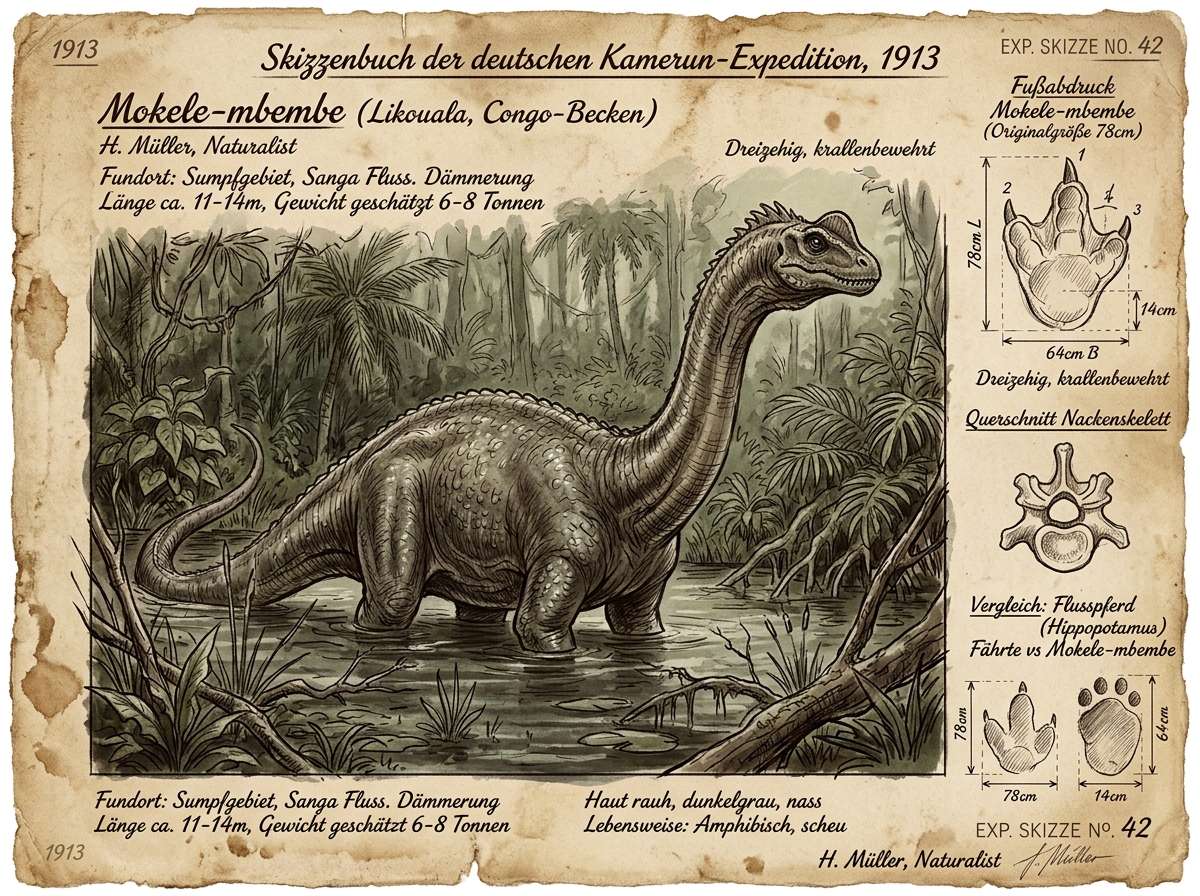
This dossier incorporates primary sketches, expedition maps, and field casts collected across two centuries of Congolese expeditions. Click on any thumbnail below to open the High-Resolution Field Sketch Lightbox Gallery:
┌────────────────────────────────────────────────────────────────────────┐
│                MOKELE-MBEMBE HISTORICAL SKETCH GALLERY                 │
├─────────┬──────────────────────────────────┬───────────────────────────┤
│ PLATE # │ SKETCH TITLE & SOURCE            │ ARCHIVE / EXPEDITION REF. │
├─────────┼──────────────────────────────────┼───────────────────────────┤
│ [PL-01] │ 1913 Von Stein Field Anatomy     │ Imperial German Colonial  │
│         │ Profile (Neck, Crest, Tail)      │ Archives, Berlin (Kamerun)│
├─────────┼──────────────────────────────────┼───────────────────────────┤
│ [PL-02] │ 1980 Roy Mackal River Footprint  │ Likouala-aux-Herbes Mud   │
│         │ Three-Clawed Plaster Cast        │ Cast, Univ. of Chicago    │
├─────────┼──────────────────────────────────┼───────────────────────────┤
│ [PL-03] │ 1983 Marcellin Agnagna Visual    │ Brazzaville Directorate of│
│         │ Lake Tele Sighting Reconstruction│ Wildlife Report No. 83-B  │
├─────────┼──────────────────────────────────┼───────────────────────────┤
│ [PL-04] │ Malombo Vine Stripping Damage    │ Botanical Laceration Field│
│         │ Landolphia owariensis Foraging   │ Photo, Powell Expedition  │
└─────────┴──────────────────────────────────┴───────────────────────────┘
(Note: Use the interactive Gallery Button in the reading surface or sidebar to view original lithographs, footprint casts, and expedition cartography in the modal lightbox).
Primary Sources & Archival Ledger
- Abbé Lievin-Bonaventure Proyart:
- Histoire de Loango, Kakongo, et autres royaumes d'Afrique (Paris: C.-P. Berton, 1776). First documentation of giant 3-foot clawed footprints in the Congo interior.
- Captain Freiherr von Stein zu Lausnitz:
- Report of the German Expedition to Kamerun 1913–1914 (Imperial Colonial Office, Berlin, 1914). Unedited archival manuscript describing Mokele-mbembe anatomy, river caves, and Malombo diet.
- Dr. Roy P. Mackal:
- A Living Dinosaur? In Search of Mokele-mbembe (Leiden: E.J. Brill, 1987). 340 pages, field maps, native interview transcripts, and footprint plaster casts.
- Searching for Hidden Animals (Garden City: Doubleday, 1980).
- Marcellin Agnagna:
- Rapport de la mission zoologique du Parc Zoologique de Brazzaville au Lac Télé (Brazzaville: Ministère des Eaux et Forêts, 1983).
- Dr. Herman Regusters:
- Mokele-Mbembe: An Investigation into the Existence of a Relict Dinosaur in the Congo Basin (Pasadena: California Institute of Technology / JPL Report, 1982).